
Trust 6 min read
How to stop AI from inventing statistics in your marketing copy

To stop AI from inventing statistics, treat every number a model writes as unverified until it is traced to a real source, and use a tool that only lets a figure appear when it is in your own data. Generic AI predicts the most likely next words, so it produces numbers that sound right and are not real. The fix is grounding: the copy can only state a fact that came from your inputs, and a human checks it before it ships.
This post explains why AI makes up statistics, what a single fake number costs you and how to catch and prevent fabrication in your marketing copy.
What is an AI hallucination in marketing?
An AI hallucination is a confident, fluent, false statement produced by a language model that has no source of truth behind the claim. In marketing copy it usually shows up as a made-up statistic ("boosts conversion by 47%"), a feature the product does not have, a customer quote nobody said or an award nobody gave you.
The word "hallucination" is soft. In a marketing context the plainer word is fabrication. The output reads as fact, carries your brand name and can be wrong in a way that a busy reviewer will not notice because it looks exactly like a real claim.
Why does generic AI make up statistics?
A general-purpose model is a text predictor. It was trained to continue a sentence with the most probable next words, not to check whether those words are true. When your prompt implies a number should be there, the model supplies the most plausible-looking number it can, because a specific figure is what usually follows that kind of sentence in its training data.
Two things make this worse for marketing:
- No source of truth for your brand. The model does not know your real conversion rate, your customer count or your pricing. It was not trained on your private data, so when it needs a brand fact it invents one that fits the pattern.
- Fluency hides the gap. A fabricated stat comes out in the same confident voice as a true one. There is no tremor in the text to warn you. That is what makes it dangerous.
So the fabrication is not a bug you can prompt away with "please be accurate". It is what an ungrounded predictor does by design. The only reliable fix is to change where the numbers are allowed to come from.
What does a made-up number actually cost you?

A single fabricated statistic in published copy can trigger real damage. Think of it in four buckets:
| Cost | What it looks like |
|---|---|
| Legal | A claim you cannot substantiate breaches advertising and consumer-protection rules |
| Trust | A prospect fact-checks one number, finds it false and doubts the rest |
| Brand | The fake figure gets quoted back to you by press, sales or an AI answer engine |
| Rework | Every asset that reused the number has to be found, corrected and reapproved |
The nasty part is spread. One invented figure in a launch post gets pasted into a deck, an email and three social posts before anyone checks it. You are not correcting one line, you are chasing a number across every channel it reached.
How to catch fabricated stats before you publish

Until your generation is grounded, treat AI drafts as unverified. Run this checklist on any number, name or hard claim in a draft:
- Ask for the source. For every statistic, find the exact document, dashboard or dataset it came from. No source means no publish.
- Search your own records first. If the figure is about your brand, it must exist in your analytics, CRM or finance data, not just in the draft.
- Distrust the suspiciously specific. Oddly precise numbers with no citation ("increases retention 3.2x") are a classic fabrication tell.
- Check names and quotes hardest. Customer names, testimonials, awards and partnerships are high-risk. Verify each one against a real record.
- Watch the links and dates. Models invent URLs and "as of" dates that look plausible. Click every link, confirm every date.
- Give it a second reader. The person who wrote the prompt is the worst person to catch its errors. Route hard claims to someone who was not in the draft.
This works, and it is slow. It puts the whole burden on a human catching a lie that was built to look like the truth. A better approach is to stop the number being invented in the first place.
What grounded generation looks like
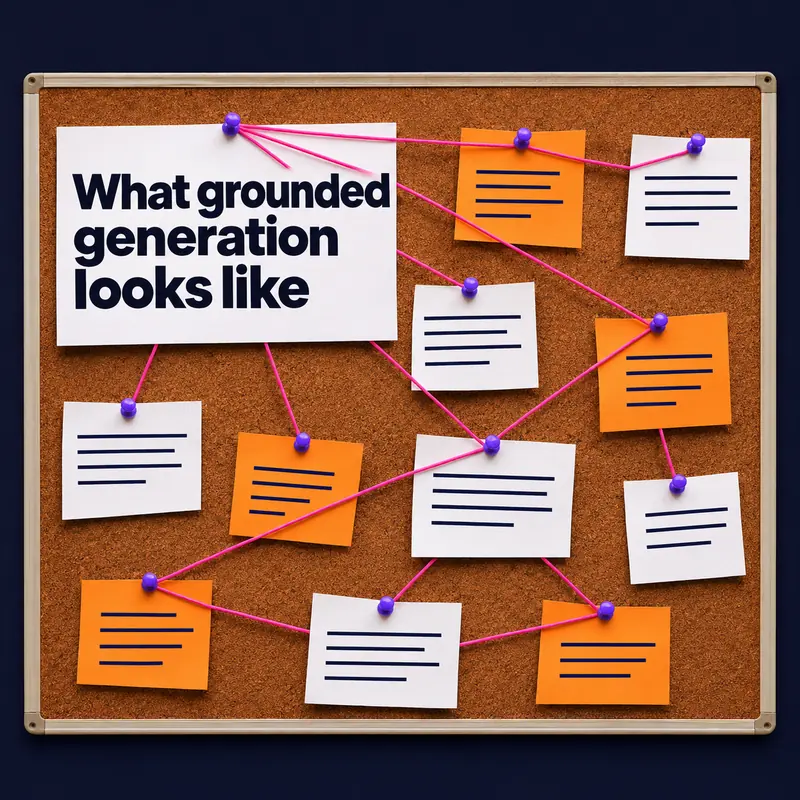
Grounded generation flips the default. Instead of letting the model write any plausible number, the copy can only state a fact that is present in your inputs. This is how Writey is built, and it is the story a generic AI writer cannot tell.
- A no-fabrication grounding rule. Every draft Writey generates is bound by one rule: write only from the brand facts, proof points, live signals and brief it is given, and never invent figures, features, quotes, names, dates or links. If a detail is not in the inputs, Writey writes around it or leaves a clear placeholder for a human, rather than guessing.
- Proof-gated numbers. A specific statistic only appears if it is backed by your proof points or your connected live data. No proof, no number. Writey reframes the unsupported claim as a benefit or a question instead of stating a fact it cannot support.
- A "why" behind every line. Each piece traces back to the evidence it was built from, so a reviewer can see where a claim came from instead of taking it on faith.
- Human review as the backstop. Grounding cuts fabrication sharply, but Writey still treats a person's approval as the final gate before anything publishes. The rule reduces the risk, the review closes it.
The result is trustworthy AI copywriting where the safe default is "say nothing you cannot support", not "fill the gap with a plausible guess". You get AI that cites sources because it can only write from them.
If you want copy that will not invent your numbers, see the formats Writey writes, read how to get cited by AI search or try grounded generation.
Frequently asked questions
Why does AI make up statistics that sound real?
Because a general model predicts the most likely next words rather than checking facts. When a sentence looks like it should contain a number, the model supplies a plausible one. It has no access to your real brand data, so it fabricates a figure that fits the pattern and reads as true.
How do I fact-check AI content quickly?
Trace every number, name, quote and link back to a real source before you publish. Anything you cannot tie to your analytics, CRM, records or a citable document gets cut. Route the highest-risk claims to a second reader who was not involved in writing the draft.
Can AI copywriting ever be trusted with numbers?
Yes, when the generation is grounded. If the tool can only state a figure that exists in your data, and a person approves the draft before it ships, the fabrication risk drops sharply. Writey proof-gates every numeric claim so a number appears only when your data backs it.